What Happens in a Class
Not sure which class to book?They are more different than the listings make them look. The cheapest bakes your pizza in a domestic electric oven, the most booked one uses a wood-fired oven, and one of them is a calzone class that never makes a round pizza at all. All of them cancel free up to 24 hours ahead, so the booking is the low-risk part — choosing is the part worth five minutes.
Compare what each one includesArrival, and the thing you eat first
Every class on this site starts with a drink, and most of them with something small to eat: bruschetta with local tomato on homemade bread on the flagship, a local Neapolitan starter on two others, a Neapolitan appetiser with a welcome prosecco or soft drink on the cheapest one. The €69 wine class and the €49 small-group class name no starter at all, only the drinks. Where it exists this is not filler. It is the fifteen minutes in which the group stops being strangers, and on the classes where the instructor uses it well the whole session runs better afterwards. Arrival times are specified and they are not decorative: fifteen minutes early on the €13 class, ten on the gelato class, at least five on the San Carlo one.
The dough, and the four things in it
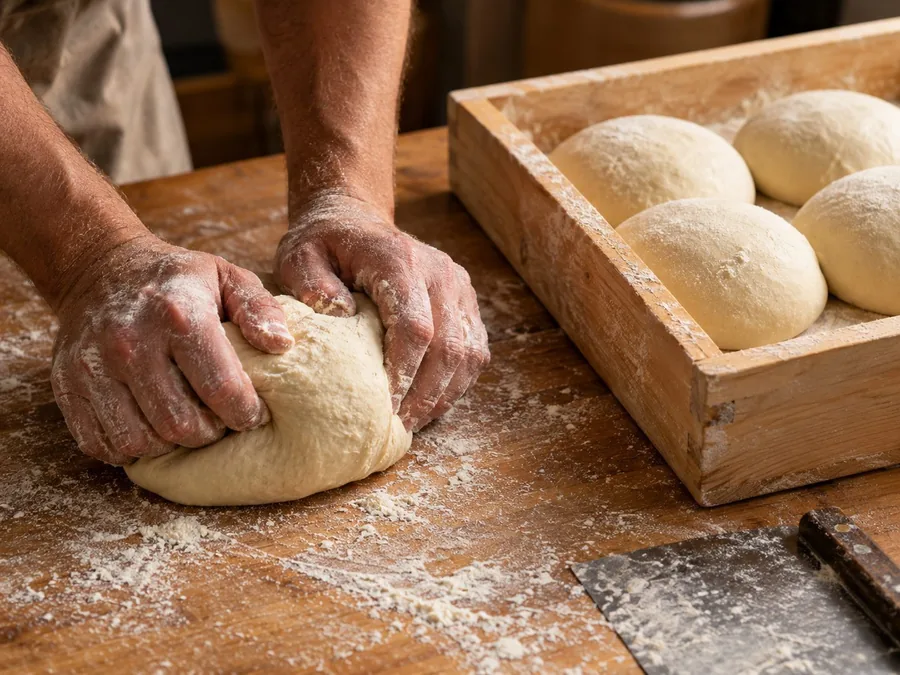
The calzone class states the recipe in its own listing and it is the whole of it: water, flour, salt and yeast. Nothing else. That is the point at which most people realise they have been overcomplicating pizza at home for years.
For scale, the EU specification for Pizza Napoletana STG sets the base batch at one litre of water, 50 to 55 grams of sea salt, 3 grams of brewer’s yeast and 1.8 kilos of soft wheat flour, type 00 or type 0, kneaded twenty minutes at low speed and fermented at 25 °C. The AVPN’s own disciplinare, which is a different document, sets different quantities for the same litre of water. You will not be weighing any of this yourself in a two-hour class, but a good instructor will tell you the ratio, and the difference between the two documents is untangled on what officially makes a pizza Neapolitan.
David, on the €69 pizzaiolo class, came away with the detail that makes the difference at home: his dough was about 60% water and the chefs’ dough had a higher water content. That is the kind of sentence a class is actually worth paying for. Stefan, on the flagship, noted the dough recipe and the kneading techniques being demonstrated rather than described.
The staglio — and the word the listings get wrong
When the bulk dough has risen, a portion is cut from it and shaped into a ball. The ball is a panetto; the act of cutting and shaping it is the staglio. The STG specification puts the panetti at 180 to 250 grams; AVPN’s disciplinare, separately, says 200 to 280 grams. Same step, two documents, two ranges.
Three of the nine listings on this site use the word mozzatura for what the hands are doing. One advertises “the traditional mozzatura technique used to divide pizza dough by hand”; the €69 wine class and the €49 small-group class both credit a “600-year-old mozzatura technique”. That is the operators’ wording and it is loose. Mozzatura is a cheesemaking step, the moment mozzarella is lopped off — the verb is mozzare, to cut off, which is where the cheese gets its name. AVPN uses the word about dough only as a simile, describing the staglio as done with a technique that recalls the making of mozzarella. If your instructor says mozzatura while dividing dough, they are speaking the way the trade speaks. The term for what their hands are doing is staglio.
Proofing, which is when the class actually happens
Dough has to wait and so do you, and that wait is where a good class earns its money. The STG spec allows a first rise of two hours, then the staglio, then a second rise of four to six hours. AVPN’s document gives a total leavening window of 8 to 24 hours. Neither fits inside a class, which is why the dough you stretch was almost always started before you arrived, and why nobody is deceiving you when it appears ready. What you are being taught in that gap is why the wait exists. Dóra’s review of the cheapest class puts it exactly right: they did not only follow the steps, they got answers to everything else they asked.
Stretching, and the rule with no exceptions
You work from the centre outwards with the fingers of both hands on the panetto, turning the ball repeatedly. Then comes the schiaffo, the slap: rapid controlled contact between the dough and the bench with an alternating movement of the hands, which widens the disc and redistributes the gas without pushing the air out. Everything you are doing is protecting the cornicione, the raised outer rim, which AVPN describes as swollen, free of burning and about one to two centimetres.
The EU specification is blunt about the alternative. In its own words: “No other type of preparation is authorised for the preparation of ‘Pizza Napoletana’ TSG, in particular the use of a rolling pin and/or a mechanical press-type disc machine.” In the Italian text, the rolling pin is expressly excluded and the stretching is exclusively manual. If you have made pizza at home with a rolling pin, this is the hour in which you stop.
Sauce, topping and the peel
San Marzano tomatoes are named on three of the nine listings. The sauce is usually crushed rather than cooked, which surprises people who have been simmering it for an hour at home. Topping is fast and deliberately sparse; the flagship lets you choose Margherita or Marinara, the calzone class fills instead of tops, and the €69 pizzaiolo class names buffalo mozzarella and fresh basil.
Then the peel. On the €25 class this is the moment the whole session is built around — you take the peel and slide your own pizza into the oven yourself. On others the pizzaiolo does it and you watch, which is a real difference between the listings and one worth checking before you book if it matters to you.
The bake, in seconds
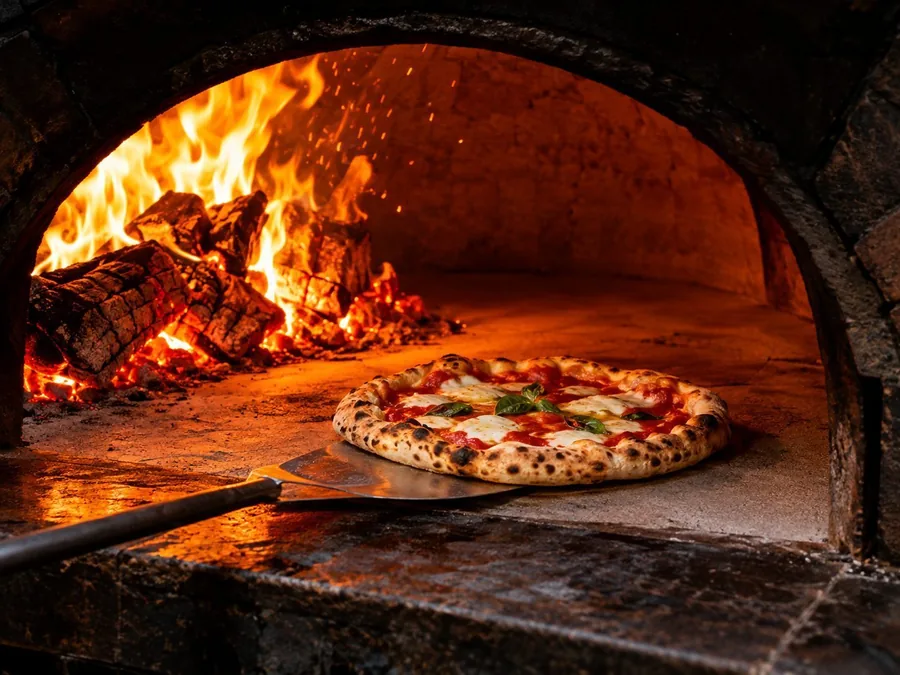
The STG specification puts a Neapolitan bake at 60 to 90 seconds on a cooking floor of about 485 °C under a dome of about 430 °C, in a wood-fired oven. AVPN’s figures, again a separate document, are 430 to 480 °C for 60 to 90 seconds. Whichever you take, the bake is over before you have finished watching it, and that is precisely what a domestic oven cannot reproduce. The classes that use a real oven are collected on the wood-fired oven page. The cheapest class bakes in a home electric oven in a steel ruoto instead, and treats that as the lesson rather than hiding it.
Eating it, and why the middle is soft
The STG describes the finished pizza as tender, elastic and easily foldable into four, with a diameter not exceeding 35 centimetres, a raised rim of one to two centimetres and a centre 0.4 centimetres thick with a ten per cent tolerance. AVPN’s document says the centre should be no more than 0.25 centimetres. Either way it is thin, and either way it is soft. A Neapolitan pizza is not meant to hold itself out flat on your hand, and the wet middle that visitors read as underbaked is the specification working. Fold it into four and eat it that way.
Seven of the nine classes end with a dessert — tiramisù on five, gelato on one, a sweet calzone made from the same dough on another. The €69 pizzaiolo class and the €49 small-group class are the two that do not. On the well-run ones the tiramisù is made first and chilled while the pizza is made, which is why some classes start with dessert and confuse people who expected to start with flour.
Ask two questions at the start: how wet is this dough, and how long did it prove. Those two answers are what you take home. How long the whole thing runs is on how long a class takes, and what to turn up in is on what to wear.
Frequently asked questions
What happens in a pizza-making class in Naples?
A drink and a small starter, the dough and its four ingredients, the staglio that forms the dough ball, a proofing pause, hand-stretching from the centre outwards with no rolling pin, sauce and topping, the peel, a bake of 60 to 90 seconds under the STG specification, and then you eat it. Two to three hours, on your feet.
Do you make the dough from scratch?
You make dough, but the dough you stretch was usually started earlier. The STG specification allows a two-hour first rise and a four-to-six-hour second rise, and AVPN’s separate document gives 8 to 24 hours of leavening, so no class can fit a full prove inside its running time.
Why is Neapolitan pizza soft and wet in the middle?
Because that is what the specification asks for. The STG puts the centre at 0.4 cm thick with a ten per cent tolerance and requires the finished pizza to be tender, elastic and easily foldable into four; AVPN’s document says no more than 0.25 cm. Fold it and eat it in your hand.
Will I be able to make pizza at home afterwards?
You will be able to repeat the shaping and you will know the ratio. You will not have a wood-fired oven, and the 60-to-90-second bake is what a domestic oven cannot do — which is the honest case argued on whether a class is worth it. Which language you will hear all this in is on the language page.